

Last January, I told myself I’d finally learn guitar. By March, I’d quit. “I just don’t have the time,” I said. Then I did the math on how many hours I really had in a year. It changed how I looked at my calendar.
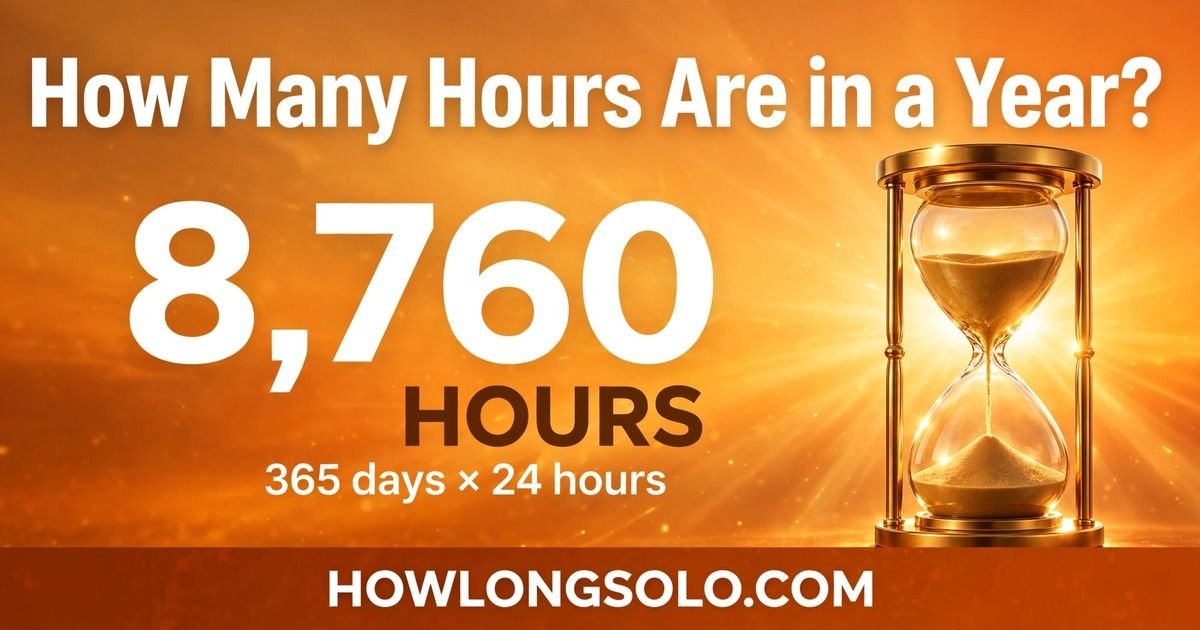
So, how many hours are in a year? A regular year has 8,760 hours. You get that by multiplying 365 days by 24 hours. A leap year has 366 days, so it has 8,784 hours. The average calendar year is a bit longer, at about 8,765.8 hours.
In this guide, you’ll see the math, a simple chart, and where your hours actually go. You’ll also learn how to turn hours into money and goals. Ready?
Live Widget
The Simple Math Behind Hours in a Year
Let’s keep this easy. A day has 24 hours. A regular year has 365 days. So you multiply.
365 × 24 = 8,760 hours
That’s it. No tricks. You can also come at it from weeks. A week has 168 hours (7 × 24), and a year has about 52 weeks. That gives you 8,736 hours. It’s close, but it’s 24 hours short. Why? Because 52 weeks only cover 364 days. The 365th day is the one people forget.
In my experience, the day-based math is the safest. It always matches the calendar.
Regular Year vs. Leap Year: Which Number Should You Use?
Most years have 365 days. Every four years, February gets an extra day, and we call it a leap year. The next one is 2028. That extra day adds 24 hours to the total.
There’s a third number, too. The Gregorian calendar, which the US uses, averages 365.2425 days per year over long stretches. That’s where the 8,765.8 figure comes from. It’s mostly useful for science and long-term planning.
| Year Type | Days | Hours | Minutes | Seconds |
|---|---|---|---|---|
| Regular year | 365 | 8,760 | 525,600 | 31,536,000 |
| Leap year | 366 | 8,784 | 527,040 | 31,622,400 |
| Average year | 365.2425 | 8,765.82 | 525,949.2 | 31,556,952 |
How Many Hours Are in a Month, Week, and Day?
Sometimes you need a smaller number. Here’s a quick list you can save.
- 1 day: 24 hours
- 1 week: 168 hours
- 28-day month: 672 hours
- 30-day month: 720 hours
- 31-day month: 744 hours
- 1 quarter (90 days): 2,160 hours
Notice that months aren’t equal. A 31-day month has 72 more hours than February in a regular year. That’s why monthly goals can feel easier in some months than others.
Does daylight saving time change the total? Good question. In the US, we lose an hour in spring and gain one in fall. They cancel out. So the local year still adds up to 8,760 hours. The spring day just has 23 hours, and the fall day has 25.
[Internal Link: How many days are in a year]
Where Do Your 8,760 Hours Go?
Here’s the part that surprised me. Let’s say you sleep 8 hours a night and work a standard full-time job.
- Sleep: 8 hours × 365 days = 2,920 hours
- Work: 40 hours × 52 weeks = 2,080 hours
- What’s left: 8,760 − 2,920 − 2,080 = 3,760 hours
That’s about 43% of your year. But hold on. That 3,760 also covers commuting, meals, chores, errands, and time with family. So your truly free time is smaller.
Still, it’s a lot more than most people think. If you spent just one hour a day on something you care about, that’s 365 hours a year. What would you do with that?
I tried this with my own week. I tracked my time for seven days. I found at least 10 hours I was giving away to scrolling. It wasn’t fun to see, but it was useful.
[Internal Link: How many hours are in a work year]
Turn Hours in a Year Into Money
The “2,080 hours” number shows up everywhere in US jobs. It’s 40 hours a week for 52 weeks. Employers often use it to switch between hourly pay and yearly salary.
Here’s the quick way:
- Hourly to yearly: multiply your hourly pay by 2,080. A $25 hourly wage becomes $52,000 a year.
- Yearly to hourly: divide your salary by 2,080. A $60,000 salary comes to about $28.85 an hour.
Keep one limit in mind. This math assumes you work every week, with no unpaid time off. If you take unpaid days, your real total will be lower. Most people make this mistake when they compare job offers. Always check how your employer counts paid time off.
Use Your Year’s Hours to Reach Big Goals
Big goals feel scary. Hours make them smaller. Here are a few examples.
100 hours a year is about 16 minutes a day. That’s enough to read a few books or build a simple habit.
1,000 hours a year is about 2.7 hours a day. That’s a serious commitment. It’s the kind of time that can take you from a beginner to a solid hobbyist in many skills.
10,000 hours is a popular number you may have heard about mastering a skill. If you practice 3 hours a day, you’d reach it in about 9 years. At 1 hour a day, it would take over 27 years. Keep in mind that experts still debate how well this idea works. Quality of practice matters as much as the clock.
So what’s a fair goal for you? Pick a number of hours, divide it by 365, and you’ll see the daily cost. That’s how I finally made peace with guitar. I set a goal of 100 hours, not “get good.”
Common Mistakes to Avoid
I’ve made a few of these myself.
Using 52 weeks × 168 hours. It gives 8,736, which misses a full day. Use 365 × 24 instead.
Forgetting leap years. If your timeline crosses February 29, add 24 hours.
Treating all 8,760 hours as usable. You can’t work or study every hour. Sleep alone takes about a third of them.
Mixing up work hours and calendar hours. A work year has about 2,080 hours, not 8,760. These are two very different numbers.
Planning with no buffer. Life happens. Sick days, trips, and bad weeks will eat your plan.
Pro Tips for Making the Most of Your Hours
Here’s what has worked for me and for people I’ve helped plan their time.
Track before you plan. Log your time for one week. You’ll find out where the hours really go.
Think in small blocks. Thirty minutes a day adds up to about 182 hours a year. Small blocks are easier to keep than big ones.
Protect your best hours. Most of us have a time of day when we focus best. Put your key task there.
Plan with 2,080 for work, 8,760 for life. Use the right number for the right question.
Review every quarter. Each quarter has about 2,160 hours. A quick check-in every three months keeps your plan honest.
FAQs
How many hours are in a year?
A regular year has 8,760 hours (365 × 24). A leap year has 8,784 hours because it has 366 days.
How many hours are in a leap year?
A leap year has 8,784 hours. That’s 24 hours more than a regular year, thanks to February 29.
How many working hours are in a year?
A standard full-time year has about 2,080 hours. That’s 40 hours a week for 52 weeks, before any unpaid time off.
How many minutes and seconds are in a year?
A regular year has 525,600 minutes and 31,536,000 seconds. A leap year has 527,040 minutes and 31,622,400 seconds.
How many hours do you sleep in a year?
If you sleep 8 hours a night, you sleep about 2,920 hours a year. At 7 hours a night, it’s about 2,555 hours.
Final Thoughts on How Many Hours Are in a Year
So, how many hours are in a year? It’s 8,760 in a regular year and 8,784 in a leap year. The average year is about 8,765.8 hours. Use 8,760 for most planning, and use 2,080 when you’re talking about a full-time work year.
Now it’s your turn. Pick one goal, convert it into hours, and write down the daily time it needs. Then share this guide with a friend who says they never have enough time. They might be surprised, just like I was.
Related Countdown Timers
