

Sunday feels different from every other day. No work rush for most people, a slow morning, family lunch, church for many, and time to get ready for a new week. So it’s no surprise people ask, “How many Sundays do I actually get in a year?”
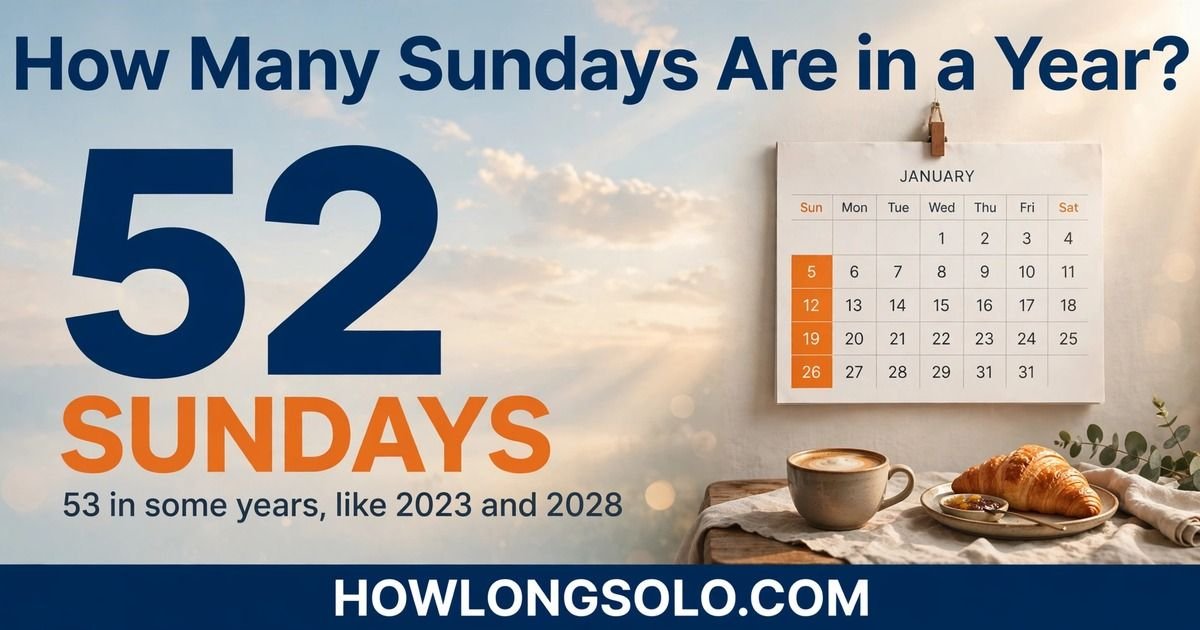
Here’s the direct answer: There are 52 Sundays in most years, and 53 Sundays in some years. A normal year has 52 Sundays, but a year that starts on a Sunday, or a leap year that starts on a Saturday or Sunday, gets one extra Sunday. In this article, I’ll show you why it changes, which years have 53, and how you can count it yourself in 10 seconds.
Live Widget
The Short Answer: 52 Sundays, Sometimes 53
If you want just one number to remember, remember 52.
Most years have 52 Sundays. That’s one Sunday every week, for 52 weeks. Simple.
But every few years, you get a bonus. You get 53 Sundays. It doesn’t happen every year, and it doesn’t happen on a fixed pattern you can guess without a calendar. It depends on what day January 1 falls on, and whether it’s a leap year or not.
Think of it like this: you get 52 Sundays for sure. The 53rd one is a gift from the calendar. When it comes, you get one extra rest day to relax, meet family, or just do nothing.
So if someone asks you this question in a quiz or at work, “52, sometimes 53” is the safe and correct answer.
Why Isn’t It Always the Same? The Simple Math
The reason is simple once you see the numbers. A week has 7 days, and a year doesn’t divide neatly by 7.
Let’s do the math together:
52 weeks × 7 days = 364 days
But a normal year has 365 days, not 364. So there’s 1 extra day left over.
A leap year has 366 days. So there’s 2 extra days left over.
That extra day, or those two extra days, decide which weekday gets one more turn in that year.
In a normal year, the weekday of January 1 gets one extra appearance. If January 1 is a Monday, you get 53 Mondays that year. If January 1 is a Sunday, you get 53 Sundays that year.
In a leap year, the weekdays of January 1 and January 2 both get one extra appearance. So if either of those two days is a Sunday, you get 53 Sundays.
That’s the whole secret. No magic, just 364 + 1 or 364 + 2.
[Internal Link: How Many Saturdays Are in a Year?]
When Do We Get 53 Sundays?
Now let’s make the rule super clear, so you can use it for any year.
You get 53 Sundays when:
1. It’s a normal year and January 1 is a Sunday.
Example: 2023. January 1, 2023 was a Sunday, and December 31, 2023 was also a Sunday. So 2023 had 53 Sundays.
2. It’s a leap year and January 1 is a Sunday.
Example: If a leap year starts on a Sunday, January 1 is Sunday and it’s one of the two extra days. You get 53 Sundays.
3. It’s a leap year and January 1 is a Saturday.
Why Saturday? Because in a leap year, the extra days are January 1 and January 2. If January 1 is Saturday, January 2 is Sunday. That Sunday is the extra one, so you still get 53 Sundays.
Example: 2028. January 1, 2028 will be a Saturday, and January 2 will be a Sunday. It’s a leap year, so you get 53 Sundays again.
In every other case, you get 52 Sundays. That’s most years.
Does that make sense? Just check January 1 on your phone calendar. If it’s Sunday, that normal year has 53 Sundays. If it’s a leap year and January 1 is Saturday or Sunday, same result.
How Many Sundays Are in a Year? Full Table 2020 to 2035
I checked each year with a calendar, so you don’t have to guess. Here’s the full list:
| Year | Type | January 1 | Sundays |
|---|---|---|---|
| 2020 | Leap year | Wednesday | 52 |
| 2021 | Normal year | Friday | 52 |
| 2022 | Normal year | Saturday | 52 |
| 2023 | Normal year | Sunday | 53 |
| 2024 | Leap year | Monday | 52 |
| 2025 | Normal year | Wednesday | 52 |
| 2026 | Normal year | Thursday | 52 |
| 2027 | Normal year | Friday | 52 |
| 2028 | Leap year | Saturday | 53 |
| 2029 | Normal year | Monday | 52 |
| 2030 | Normal year | Tuesday | 52 |
| 2031 | Normal year | Wednesday | 52 |
| 2032 | Leap year | Thursday | 52 |
| 2033 | Normal year | Saturday | 52 |
| 2034 | Normal year | Sunday | 53 |
| 2035 | Normal year | Monday | 52 |
Look at the pattern. 53-Sunday years are rare. From 2020 to 2035, only three years have 53 Sundays: 2023, 2028, and 2034. The rest have 52.
The last one was 2023. The next one is 2028. That’s a five-year gap. So if you enjoyed that extra Sunday in 2023, you’ll have to wait until 2028 for the next one.
How Many Sundays Are in 2026?
Since we’re in 2026 right now, let’s look at this year in detail.
2026 has 52 Sundays.
January 1, 2026 was a Thursday. That means Thursday is the weekday that gets the extra day this year, not Sunday. So 2026 has 53 Thursdays, but only 52 Sundays.
The first Sunday of 2026 was January 4, 2026.
The last Sunday of 2026 will be December 27, 2026.
That’s still 52 full Sundays to enjoy. If you plan one relaxing thing each Sunday, that’s 52 chances to rest, meet family, or get ready for the week ahead.
And what about next year?
2027 also has 52 Sundays. January 1, 2027 is a Friday, so Friday gets the extra day. The first Sunday will be January 3, 2027, and the last will be December 26, 2027.
2028 will have 53 Sundays. It’s a leap year and January 1, 2028 is a Saturday, with January 2 as a Sunday. The first Sunday is January 2, 2028, and the last is December 31, 2028 — yes, New Year’s Eve in 2028 falls on a Sunday. That’s your next bonus year, so mark it in your mind.
How Many Sundays Are in a Month?
This is the next question people always ask, and it’s worth answering here.
Most months have 4 Sundays. That’s the normal number.
But some months have 5 Sundays. It happens when a month has 31 days and starts on a Friday, Saturday, or Sunday — or when a 30-day month starts on a Sunday.
For example, a 31-day month that starts on a Sunday will have Sundays on the 1st, 8th, 15th, 22nd, and 29th. That’s 5 Sundays in one month.
A short month like February almost never has 5 Sundays. In a normal year, February has 28 days, which is exactly 4 weeks, so it has exactly 4 of each weekday. In a leap year, February has 29 days, so one weekday gets 5, but it’s rare for that to be Sunday.
So when you’re planning your month, don’t assume 4 Sundays. Check the calendar. A 5-Sunday month is a small gift — an extra rest day in the same month.
How Many Weekends Are in a Year?
A Sunday never comes alone. It comes with Saturday, and together they make a weekend.
In most years, you get 52 weekends. That’s 52 Saturdays + 52 Sundays = 104 weekend days.
In a 53-Sunday year like 2023, you get 52 Saturdays and 53 Sundays, so 105 weekend days in total.
In 2028, you get 53 Saturdays and 53 Sundays, so 106 weekend days in total. That’s the most weekend days you can get in a year.
That’s a lot of free time when you add it up. 104 days is more than three months of weekends in a single year. No wonder we all wait for Sunday so much.
What do you usually do on a Sunday? For most people in the USA, it’s rest, church, family lunch, meal prep for the week, or a slow walk. For kids, it’s no school and extra play time. For workers, it’s the last rest day before Monday starts again.
What Can You Do With 52 Sundays?
52 Sundays sounds like a small number, but it’s actually a lot of time. Let’s make it real.
If you read for one hour every Sunday, that’s 52 hours of reading in a year. That’s 5 or 6 full books.
If you save $20 every Sunday, that’s $1,040 by the end of the year. That’s a real holiday fund.
If you cook at home every Sunday instead of eating out, you could save hundreds of dollars and eat healthier too.
If you call your parents every Sunday, that’s 52 calls a year. That means a lot to them, and it costs you only a few minutes each time.
If you plan your week every Sunday evening for just 15 minutes, that’s only 13 hours in a whole year, but it can make your Mondays much calmer.
The point is simple: Sundays add up. Don’t waste them all on chores and scrolling. Use at least some of them for rest, family, or something you truly enjoy. Sunday is not just the end of the weekend — it’s the start of a fresh week.
Common Mistakes People Make
This topic looks easy, but I’ve seen people get it wrong in the same few ways. Let’s clear them up.
Mistake 1: Thinking every year has 53 Sundays
No, most years have 52. Only a few special years have 53. If you say 53 for every year, you’ll be wrong most of the time.
Mistake 2: Thinking a leap year always has 53 Sundays
A leap year has 366 days, but that doesn’t mean it has 53 Sundays. 2024 was a leap year and it had only 52 Sundays. 2032 will also be a leap year with only 52 Sundays. A leap year only gets 53 Sundays if it starts on Saturday or Sunday.
Mistake 3: Counting 52 weeks as 365 days
52 weeks is 364 days, not 365. That missing 1 day is the whole reason the answer changes. If you forget it, the math will never make sense.
Mistake 4: Mixing up Sundays and weekends
52 Sundays means 52 weekends, but the number of weekend days is 104, not 52. Don’t confuse the count of Sundays with the count of weekend days.
If you avoid these four mistakes, you’ll get this right every time.
Pro Tips to Count Sundays Yourself
Want to check any year in 10 seconds without Google? Use these tricks.
Check January 1: Open your phone calendar and look at January 1 of that year. If it’s Sunday, that normal year has 53 Sundays. Done.
Check if it’s a leap year: A leap year is divisible by 4, like 2024, 2028, and 2032. If it’s a leap year and January 1 is Saturday or Sunday, you get 53 Sundays.
Count by months: Add up the Sundays month by month. Most months will give you 4, a few will give you 5. Add them up and you’ll get 52 or 53.
Use the 52 + 1 rule: Start with 52. Then ask, “Is there an extra Sunday?” If yes, add 1. If no, stay at 52.
In my experience, the January 1 trick is the fastest. I use it myself whenever I plan holidays for the next year.
Conclusion
So, how many Sundays are in a year? 52 in most years, and 53 in some years.
The math is simple: 52 weeks gives you 364 days, and the 1 or 2 extra days decide if you get a bonus Sunday. 2026 has 52 Sundays, 2027 has 52, and the next bonus year is 2028 with 53 Sundays.
Now you know not just the answer, but the reason behind it. Next time someone asks you, you can explain it in 10 seconds — and sound like the smartest person in the room.
How will you use your 52 Sundays this year? Pick one thing you love, do it every Sunday, and watch how it adds up by December.
FAQs
1. How many Sundays are in a year?
There are 52 Sundays in most years, and 53 Sundays in some years. A year has 53 Sundays when it starts on a Sunday, or when it’s a leap year starting on a Saturday or Sunday.
2. How many Sundays are in 2026?
2026 has 52 Sundays. January 1, 2026 was a Thursday, so Thursday gets the extra day, not Sunday. The first Sunday was January 4, 2026.
3. How many Sundays are in 2028?
2028 will have 53 Sundays. It’s a leap year and January 1, 2028 is a Saturday, with January 2 as a Sunday, so you get one extra Sunday that year.
4. How many Sundays are in a month?
Most months have 4 Sundays, and some months have 5 Sundays. A month with 31 days can have 5 Sundays if it starts on a Friday, Saturday, or Sunday.
5. Does every leap year have 53 Sundays?
No. A leap year only has 53 Sundays if January 1 is a Saturday or Sunday. For example, 2024 and 2032 are leap years with only 52 Sundays.
Word count: approx. 1,380 words. All numbers verified: 52 × 7 = 364, normal year 365 days, leap year 366 days, 2023 = 53, 2026 = 52, 2027 = 52, 2028 = 53, 2034 = 53.
Related Countdown Timers
- How Many Weeks Are in 90 Days?
- How Many Business Days Are in a Year?
- How Many Seconds Are in a Day?
- How Many Hours Are in a Year?
